Is your AI inference cost ready for the next demand spike?
Partner with ISHIR to optimize AI costs, scale inference intelligently, and turn AI spending into measurable business value.

What happens when your AI application becomes successful, customer demand triples, and your inference bill grows faster than your revenue?
For many CEOs, CTOs, and startup founders, this is becoming a serious operational question.
According to McKinsey’s 2026 State of AI report, one in five organizations is already limiting AI usage because of operating costs, including tokens. Meanwhile, 44% report scaling AI across their enterprise.
That creates a difficult equation.
Businesses want more AI adoption, greater automation, and better customer experiences. But increased consumption can produce unpredictable operating expenses, especially during peak seasons.
Think about:
Does every interaction require the most powerful and expensive frontier AI model?
Absolutely not.
Enter AI Burner Models: a practical approach to deploying temporary, cost-optimized AI capacity for high-volume workloads.
The term AI Burner Models is an informal architectural concept, rather than an established industry standard. It describes a combination of proven techniques, including smaller language models, intelligent model routing, elastic inference, caching, and temporary capacity provisioning.
The objective is straightforward: use the right amount of AI intelligence, at the right time, for the right cost.
For executives developing their CEO AI strategy in 2026, this deserves attention before the next demand surge arrives.
AI Burner Models are lower-cost AI models or temporary inference deployments assigned to defined workloads during periods of elevated demand.
Instead of sending every request to a premium large language model (LLM), organizations classify requests by complexity, business importance, and risk.
A simple order-status inquiry might require a database lookup. A product recommendation might use a small language model. A complicated insurance dispute might require a more capable model with human review.
The architecture can adjust as demand changes.
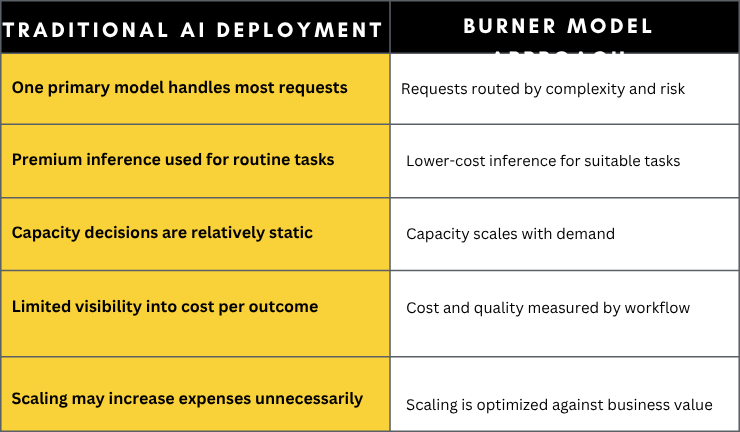
The opportunity is already visible in production engineering discussions.
How to act
The cost of an AI interaction depends on more than the advertised price per million tokens.
Total cost can include input and output tokens, repeated context, retrieval, tool calls, retries, infrastructure, monitoring, and human intervention.
Consider a hypothetical e-commerce application:
Illustrative monthly inference scenario
Monthly AI requests
1,500,000
Requests suitable for smaller models
70%
Premium cost/request ($)
Smaller model cost/request ($)
All-premium cost
$18,000
Mixed-model cost
$7,500
Potential direct inference savings: 58.3%
Hypothetical assumptions, not observed savings or vendor pricing. Excludes routing overhead, retries, evaluation, hosting, and operational costs. Savings require acceptable quality.
A small difference in cost per interaction becomes material at millions of requests.
Gartner’s analysis of failed generative AI projects identifies escalating total cost of ownership as a common problem. It recommends GenAI FinOps, prompt caching, model routing, and continuous cost monitoring.
How to act
One of the most common AI implementation barriers is unnecessary model complexity.
Organizations frequently begin with a capable frontier model because it performs well during prototyping. Over time, that initial choice becomes embedded in the architecture.
The problem appears when a successful prototype encounters production-scale demand.
A retailer might use the same model to answer questions about shipping policies, generate personalized recommendations, and resolve unusual refund disputes.
These tasks have different requirements.
An intelligent AI architecture should distinguish between retrieval, generation, reasoning, and decision-making.
Cloudflare’s AI Gateway documentation describes dynamic routing that can select models based on conditions, enforce budgets, apply rate limits, and use fallbacks. These capabilities show how model routing can become a configurable operational policy rather than hard-coded application logic.
How to act
The cheapest model is not necessarily the most economical. A low-cost model that repeatedly fails and triggers expensive retries may cost more per successful outcome.
Peak demand creates pressure on latency, throughput, provider rate limits, and application reliability.
Deploying a cheaper model alone will not solve those problems.
Organizations need elastic inference architecture that can respond to demand while protecting service quality.
This can include managed inference APIs, autoscaling endpoints, serverless deployments, queue-based processing, and temporary reserved capacity.
The economics depend on utilization. Self-hosting may make sense for predictable, high-volume workloads, while pay-per-use inference may be preferable for short, irregular spikes.
Cloudflare documents pay-per-use inference and AI gateway features for routing, rate limiting, and observability, illustrating one possible implementation approach.
How to act
A burner deployment should be easy to activate, observe, and retire. Its temporary nature must never make it operationally disposable.
AI spending can grow even when business value remains uncertain.
PwC’s 2026 Global CEO Survey, covering 4,454 CEOs across 95 countries and territories, found that only 12% reported both cost and revenue benefits from AI, while 56% reported no significant financial benefit to date.
These findings do not measure Burner Models specifically. They reveal a broader issue: AI adoption alone does not guarantee financial returns.
For peak-season AI, leadership teams should measure outcomes such as successful automated resolutions, customer satisfaction, avoided support costs, conversion rates, and cost per completed transaction.
An application can reduce token spending while worsening customer experience. That would be a poor trade.
How to act
A useful executive metric is:
\text{AI ROI}=\frac{\text{Realized Business Value}-\text{Total AI Cost}}{\text{Total AI Cost}}\times100
For Burner Models, the calculation must account for any changes in quality, customer retention, revenue, and operational risk.
A temporary AI deployment still processes real customer data and influences real business outcomes.
That makes governance essential.
Deloitte’s 2026 State of AI in the Enterprise report found that only 21% of organizations planning agentic AI deployment reported having a mature agent governance model.
For Burner Models, risks include inaccurate answers, unauthorized data access, inconsistent outputs between models, and weak audit trails.
Consider an insurance company using a smaller model during renewal season. The model might summarize policy information, but coverage determinations and consequential decisions require appropriate controls and authorized review.
Cost optimization cannot justify weakening those controls.
How to act
Organizations should also assess third-party provider retention policies, data residency, and applicable regulations before introducing new inference vendors.
An impressive prototype may process hundreds of requests. A successful product may need to process millions.
The underlying engineering challenges are very different.
Deloitte’s 2026 research found that only 25% of surveyed organizations had moved at least 40% of their AI pilots into production.
How to act
The lesson for startups is especially relevant. A prototype that performs well with a handful of customers may need substantial engineering before it can support a national product launch.
Sometimes the best way to reduce inference costs is to avoid unnecessary inference entirely.
Applications repeatedly send similar questions, lengthy system prompts, tool definitions, and conversation histories to AI providers.
Two approaches can help.
Prompt caching reuses previously processed portions of identical prompt prefixes where supported.
Response caching reuses a prior answer when a request is sufficiently equivalent and the answer remains valid.
Cloudflare’s 2026 prompt-caching documentation explains that reusing previously computed input representations can reduce processing time and discounted input-token costs for supported models.
Caching is particularly useful for repetitive customer-service requests, stable product documentation, and standardized workflow instructions.
It requires care. Customer-specific responses, rapidly changing information, and sensitive data should not be cached indiscriminately.
How to act
A well-designed system should determine whether a request needs AI at all before deciding which AI model should process it.
AI cost management cannot remain an isolated engineering responsibility.
The CIO may own infrastructure. The CFO controls budgets. Product leaders own customer outcomes. Security teams establish risk requirements.
Without clear accountability, each function can optimize for a different goal.
The CFO may demand lower inference spending while the product team wants faster responses. Engineering may select a cheaper model without knowing its effect on conversion rates or customer retention.
McKinsey’s 2025 State of AI research found that high-performing organizations were three times more likely than others to strongly agree that senior leaders demonstrated ownership and commitment to AI initiatives.
That finding concerns AI performance broadly, but the leadership principle applies directly to AI economics.
How to act
The board should ask for the cost of delivering a successful AI-enabled business outcome, alongside adoption and infrastructure spending.
AI maturity for executives should be evaluated through operational readiness, rather than the number of models deployed or AI licenses purchased.
A startup preparing for its first major launch and an enterprise preparing for Black Friday have different budgets and risk profiles. Both benefit from disciplined preparation.
A practical 90-day implementation roadmap
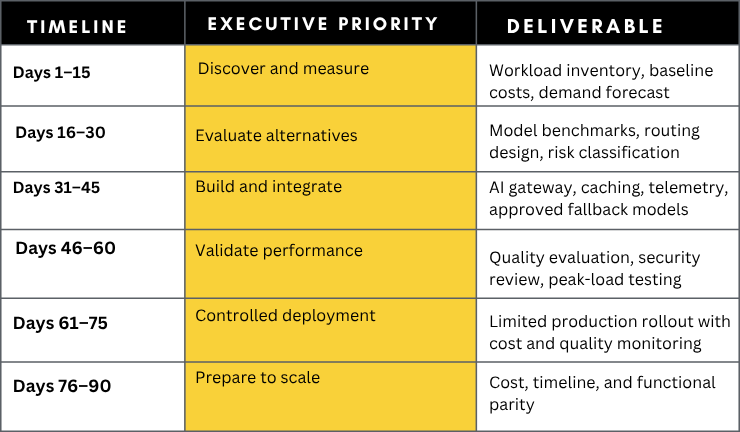
These are planning targets, not guaranteed implementation timelines. Regulated workloads and complex legacy environments may require longer.
A useful readiness question for leadership is:
If our AI usage increased fivefold next month, would our architecture, unit economics, and governance still work?
If the answer is unknown, the organization needs a peak-demand readiness assessment before committing to greater AI adoption.
At ISHIR, we work with founders, CEOs, CIOs, CTOs, and technology leaders to build AI-native digital products and modernize enterprise systems.
As an AI-native system integrator, AI-powered software development company, and AI and digital transformation partner, ISHIR helps organizations address the engineering and business decisions involved in scaling AI.
For companies exploring AI Burner Models, the work can include:
ISHIR’s approach begins with understanding the business problem and establishing measurable success criteria.
For a retailer, that might mean lowering the cost per successfully resolved customer inquiry during holiday demand. For a startup, it might mean preserving gross margins as AI usage grows. For an insurer, it could mean scaling document processing while maintaining auditability and appropriate human review.
The technology choices should follow those outcomes.
The goal is to move from Token Maxing to Value Maxing.
Partner with ISHIR to optimize AI costs, scale inference intelligently, and turn AI spending into measurable business value.
AI Burner Models are a proposed approach to using temporary, cost-optimized AI capacity for specific workloads, particularly during periods of high demand. They can include smaller language models, dynamically routed inference services, and short-lived deployments. The term is informal and is not an established technical standard. The underlying technologies are already used in production AI systems.
They direct suitable tasks toward less expensive models or non-generative workflows. They can also use caching to reduce repeated processing. Savings depend on workload complexity, token consumption, deployment costs, and quality requirements. Organizations should measure cost per successful outcome rather than relying on model pricing alone.
Yes. A small language model describes a class of models with relatively limited size and computational requirements. A Burner Model describes how an organization temporarily uses cost-optimized AI capacity. Smaller language models may be part of that architecture. Burner deployments can also use managed inference services or specialized models.
Startups can benefit when their AI applications experience unpredictable demand or usage-based costs. Model routing can help protect margins without requiring a large permanent infrastructure investment. Startups should first establish that customers value the underlying product. Cost optimization becomes more useful when it supports a validated business model.
Retail, insurance, financial services, travel, and customer-support-intensive businesses are natural candidates. These industries often experience predictable seasonal peaks or sudden demand spikes. However, the opportunity depends on whether workloads can be safely divided by complexity and risk. A detailed workload assessment is more reliable than selecting an architecture based on industry alone.
There is no universal savings percentage. Results depend on the share of requests that smaller models can handle, the difference in model costs, and additional operational expenses. Caching and deterministic workflows may provide further savings. Companies should run controlled benchmarks and use their own production traffic to estimate financial returns.
They can, especially on complex reasoning or specialized tasks. Smaller models may perform adequately on narrowly defined, repetitive workflows. Evaluation should use real examples and measurable acceptance criteria. High-risk or difficult requests should be escalated to more capable systems or human reviewers.
Intelligent model routing selects an appropriate model or processing path for each request. Routing decisions can consider task complexity, user permissions, latency, cost, and risk. A routing system may also support fallback providers when a service is unavailable. Its performance should be monitored continuously as models and workloads change.
Elastic AI infrastructure adjusts inference capacity as workload demand changes. Organizations can use managed APIs, autoscaling deployments, or serverless inference services. The appropriate choice depends on utilization patterns, latency requirements, and infrastructure costs. Effective scaling also requires rate limiting, queues, monitoring, and failure recovery.
The largest risk is optimizing for lower cost while weakening reliability, accuracy, or security. A poorly selected model may generate incorrect responses or increase expensive escalations. Temporary deployments can also introduce governance gaps if they are poorly controlled. Organizations should maintain consistent evaluation, access controls, logging, and human oversight.
Yes, provided the architecture accounts for the complexity of agentic workflows. Different agent tasks may require different model capabilities and permissions. Routine classification or extraction may use smaller models, while complex planning may need stronger reasoning. Organizations must evaluate the entire workflow, including tool calls, retries, and downstream actions.
CFOs should examine total cost of ownership and business outcomes rather than token prices in isolation. Useful metrics include cost per resolved case, cost per transaction, and gross margin per AI-enabled product. They should also consider infrastructure, monitoring, security, and human review expenses. Budget accountability should be shared with product and technology leadership.
Organizations with greater AI maturity typically have better processes for measuring quality, cost, risk, and operational performance. These capabilities make model optimization easier to manage. Less mature organizations should establish evaluation and governance foundations before introducing complex routing. Maturity should be measured by repeatable operational capabilities and business results.
A limited pilot may be possible within several weeks when the application already has reliable data, APIs, and evaluation processes. Complex enterprise deployments can take longer because of integration, security, and compliance requirements. Implementation should begin with a small number of well-defined workloads. Expansion should follow successful quality, reliability, and financial testing.
ISHIR can help organizations assess workloads, model economics, technical architecture, and business objectives. Its AI-native engineering and integration capabilities support the design of routing, caching, monitoring, and scalable inference systems. The work can also include governance, application modernization, and AI agent development. The objective is to establish measurable value before expanding deployment.
The next peak season will test more than the capacity of your AI infrastructure.
It will test your ability to manage costs, maintain quality, protect customer trust, and respond to demand without sacrificing margins.
AI Burner Models offer one possible architectural approach. They work best when combined with intelligent routing, disciplined engineering, strong governance, and clear financial accountability.
For CEOs and boards, the question is no longer simply how much AI the organization can deploy.
It is how much measurable business value the organization can generate from every dollar invested in AI.
Is Your AI Architecture Ready for the Next Demand Spike?
If your organization is preparing for seasonal demand, scaling an AI-native product, or facing unpredictable inference costs, now is the time to assess your architecture.
Connect with ISHIR to explore an AI Cost and Scalability Assessment focused on your workloads, model selection, cost drivers, operational risks, and opportunities for improvement.
Visit ISHIR.com to start the conversation.
Scale intelligently. Control your AI economics. Move from Token Maxing to Value Maxing.
The post AI Burner Models: How Enterprises and Startups Can Scale AI During Peak Seasons Without Overspending appeared first on ISHIR | Custom AI Software Development Dallas Fort-Worth Texas.


